

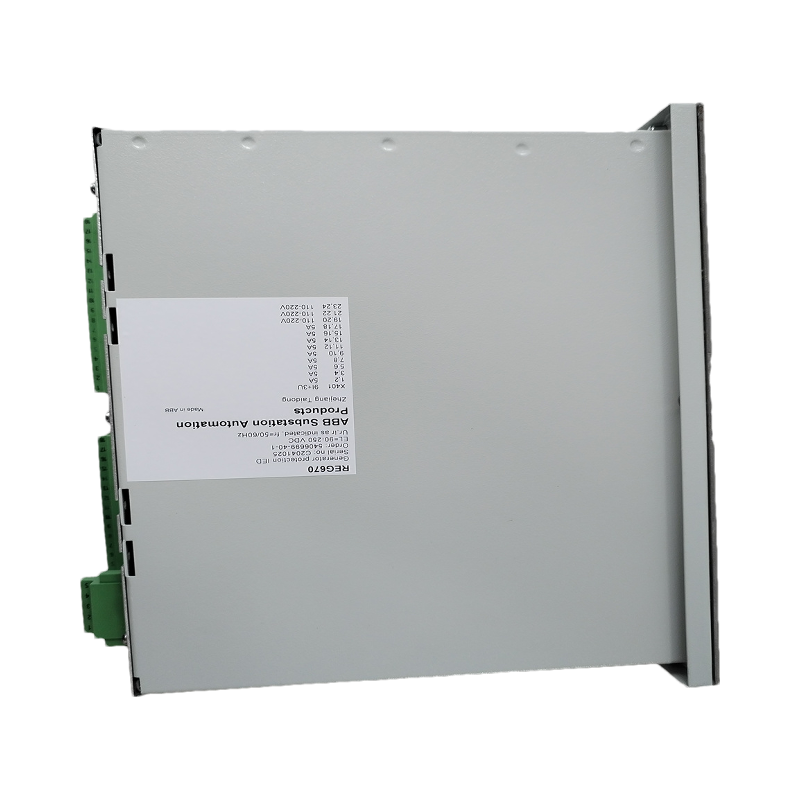

Technical Specifications
-
Electrical Parameters:
- Rated Voltage: Up to 36 kV for generator terminals and 110–250 V DC for auxiliary power .
- Rated Current: Supports CT inputs up to 5,000 A with configurable ratios (1 A or 5 A secondary) .
- Frequency Range: 47.5–63 Hz for both 50 Hz and 60 Hz systems .
-
Input/Output Interfaces:
- Analog Inputs: 16 channels for current (I) and voltage (U) measurements, supporting direct CT/PT connections .
- Digital Inputs/Outputs: 32 DI and 16 DO with opto-isolation for breaker control, alarms, and interlocking .
- Communication Protocols: IEC 61850, DNP3, Modbus TCP, and PROFIBUS DP for SCADA integration .
-
Environmental Ratings:
- Operating Temperature: -20°C to +70°C (-4°F to +158°F) with humidity up to 95% non-condensing .
- Protection Class: IP66/67 for harsh environments, including corrosive conditions in power plants .
- Vibration/Shock Resistance: Withstands 5 g (50–2,000 Hz) and 50 g (11 ms duration) shocks .
-
Physical Dimensions:
- Size: 230 mm (width) × 300 mm (height) × 130 mm (depth), weighing approximately 4.3 kg (9.5 lbs) .
- Mounting: Rack-mountable design for easy installation in control panels .
Functional Features
-
Comprehensive Protection Suite:
- Differential Protection: Fast-acting generator differential (87G) with harmonic restraint and CT saturation detection, operating in <15 ms under fault conditions .
- Stator/Rotor Earth Fault Protection:
- 100% Stator Coverage: Injection-based (861850-9-2) or third harmonic (3U0) methods to detect ground faults at any point in the winding .
- Rotor Earth Fault: Sensitive injection-based protection (64R) with adjustable impedance thresholds .
- Overcurrent/Undervoltage: Multi-step inverse-time overcurrent (51/50) and under/overvoltage (27/59) protection with voltage-controlled tripping .
- Specialized Functions: Pole slip (78), loss of excitation (40), negative sequence (46), and overspeed protection for turbine-driven generators .
-
Modular Configuration:
- Three Standard Configurations:
- A20: Generator differential + backup protection (12 AI, 7I + 5U) .
- B30: Dual differential protection for generator-transformer blocks (24 AI, 9I + 3U × 2) .
- C30: Combined generator and transformer protection (24 AI, 9I + 3U + 6I + 6U) .
- Field-Programmable Logic: User-configurable function blocks (e.g., timers, logic gates) for custom control sequences .
- Three Standard Configurations:
-
Diagnostics and Monitoring:
- Self-Supervision: Continuous monitoring of internal components (CPU, memory, communication) with fault alarms and event logging .
- Disturbance Recorder: Captures high-resolution waveform data (up to 1,000 samples/cycle) for post-fault analysis .
- Synchrophasor Measurement: Supports PMU (Phasor Measurement Unit) functionality for grid stability analysis .
-
Advanced Control Capabilities:
- Synchronization: Auto-synchronization (25) with voltage/frequency matching for generator paralleling .
- Apparatus Control: Direct breaker control (52) with interlocking and failure detection (50BF) .
- Adaptive Load Shedding: Dynamic load management based on real-time power system conditions .
Application Scenarios
-
Power Generation Facilities:
- Thermal/Hydroelectric Plants: Protects steam, gas, and hydro turbines from faults like stator winding short circuits and rotor ground faults .
- Combined Cycle Plants: Integrates with ABB’s Symphony Plus DCS for coordinated control of gas turbines and generators .
- Nuclear Power Stations: Meets stringent safety requirements with redundant protection schemes and fail-safe design .
-
Industrial and Renewable Energy:
- Wind Farms: Provides grid-compliant protection for doubly-fed induction generators (DFIGs) during grid faults .
- Solar Power Plants: Controls voltage and frequency stability in photovoltaic (PV) inverter-coupled generators .
- Mining/Manufacturing: Protects large industrial generators in remote locations with extended temperature and humidity tolerance .
-
Grid-Supporting Applications:
- Synchronous Condensers: Maintains reactive power stability in weak grids by emulating synchronous generator behavior .
- Microgrids: Enables seamless transition between grid-connected and islanded modes with advanced load balancing .
Operational Advantages
- Reliability: Redundant power supplies and hot-swappable modules ensure continuous operation during maintenance .
- Interoperability: Seamless integration with ABB’s Symphony Plus and third-party systems via open protocols .
- Cost Efficiency: Reduces equipment count by consolidating protection, control, and metering into a single IED .
- Lifecycle Support: Spare parts availability for 15 years post-discontinuation and firmware updates for evolving grid standards .
Key Considerations
- Installation:
- CT/PT Connections: Requires precise phase alignment and ratio matching to avoid differential protection maloperation .
- Cable Length: Maximum 100 m for analog signals; 200 m for digital interfaces with repeaters .
- Configuration:
- Software Tools: ABB’s PCM600 and Relion® Manager enable graphical programming and setting customization .
- Cybersecurity: Built-in IEC 62351-8 compliance for secure communication in smart grid environments .
Discover our other products
KEBA Keba Kemro K2-400 BL 450/A Part # 054202 Rev. 15 Bus Coupling Card
KEBA KEBA DI-325 / DI325 (USED)
KEBA Keba C5G-TP5WC2 Comau SPA Teach Pendant TP5 CR17910086
KEBA Keba C5G-TP5WC2 Comau SPA Teach Pendant TP5 CR17910086
KEBA Keba LSN Servomotor with Brake 1.32kW RPM=3000 Keba LSN-097-0510-3 0-320/T1MBS4
KEBA Used KEBA teach pendant Ketop T50 R01 VX/69908/14
KEBA KEBA KETOP JB 001/A SET gateway module brand new
KEBA 1PC USED KEBA T208-m00-AR0-C E6 Teach Pendant
KEBA KEBA KeTop CT200 D3 Brand New –
KEBA KEBA AT-4041 Linz KETOP T50 014 CES/73943/08 Robot teach pendant #F9


There are no reviews yet.